
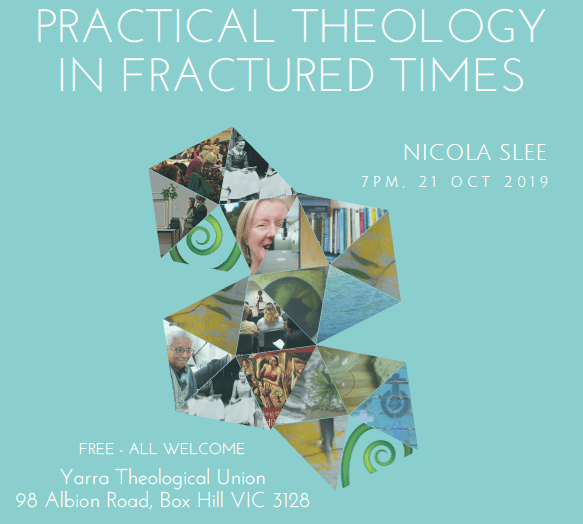
A lecture offering a State of the Union on Practical Theology
Monday 21st October, 2019
7pm, YTU
Event Details
Nicola Slee offers a State of the Union on Practical Theology. Slee argues, “Practical and feminist theologies highlight the vocation of all theology to be concerned with the lives and practices of ordinary believers and with the imperative of gender justice.” What can these learnings offer us in these fractured times?
For three decades Nicola has been at the forefront of Christian feminist theology. Her work brings forward three main areas of concern:
i) qualitative research in practical theology , ii) poetry and theology and iii) worship and spirituality An Anglican laywoman, Nicola is an honorary vice-president of Women and a regular speaker at Greenbelt.
NICOLA SLEE is Director of Research at The Queen’s Foundation for Ecumenical Theological Education, Birmingham, and Queen’s Professor of Feminist Practical Theology at Vrije Universiteit (Free University), Amsterdam. She chairs the British and Irish Association of Practical Theology.

Fragments for Fractured Times:What Feminist Practical Theology Brings to the Table by Nicola Slee available here.
The inaugural Oratie offered by Nicola Slee when she became a Professor in September 2017 to which our 2019 lecture alluded and which is the lead article of the above book.
“Yet, feminist practical theology looks to reconstruct from the rubble of what is fallen, gathering the scattered fragments of what diners at the tables of power have discarded, seeking to make bread out of stone. A characteristic stance of both feminist and practical theologies is the search for connections between the fragments within an epistemology of relationality and interconnection, a kind of to-ing and fro-ing between the overarching claims of systematic theologies, on the one hand, and an acute listening to the neglected margins, on the other. This is a theological approach that is modest yet visionary: attentive to the diversity and particularity of things. It seeks to hold each fragment up to the light for critical scrutiny but also for appreciation, finding joy in the small, fragile thing. It analyzes and responds to brokenness with realism and hopefulness, not looking to fix things so much as to hold and bear them. Refusing to impose an artificial unity upon the many fractured parts, such theologies nevertheless seek a larger whole that might be assembled from the fragments – a whole that is always ahead of us, never fully envisaged or realized.”
Nicola Slee
 Australian Collaborators in Feminist Theologies